Take a look and decide whether this affects your tenant, users or support teams.
Primary Audience
Why this score?
AT A GLANCE
END USERS
IT ADMINS
ROLLOUT TIMELINE
November 2026
📢 Official Microsoft Message Center Announcement
Microsoft Teams: Phishing detection for messaging
Message ID: MC1519866
[What and why]
Microsoft Teams is introducing AI-powered, context-aware phishing detection to help identify phishing, social engineering, impersonation attempts, and deceptive intent. The capability analyzes conversation context to identify suspicious behavior that may not include traditional indicators such as malicious links or files.
[Rollout schedule]
- Targeted Release: Beginning in early November 2026 and expected to complete by mid-November 2026
- General Availability (Worldwide): Beginning in early December 2026 and expected to complete by mid-December 2026
[Impact on your organization]
Who is affected
- For most users, detection focuses on external first-contact chats.
- Teams mobile users in China may also receive additional phishing and fraud protection for in-tenant conversations.
Platforms and services
- Microsoft Teams
What will happen
- Teams will use AI-powered, context-aware detection to identify potential phishing and related suspicious behavior.
- During initial quality validation, detection may run in the background without showing warnings to users.
- After validation, users may see a warning when potential phishing is detected:
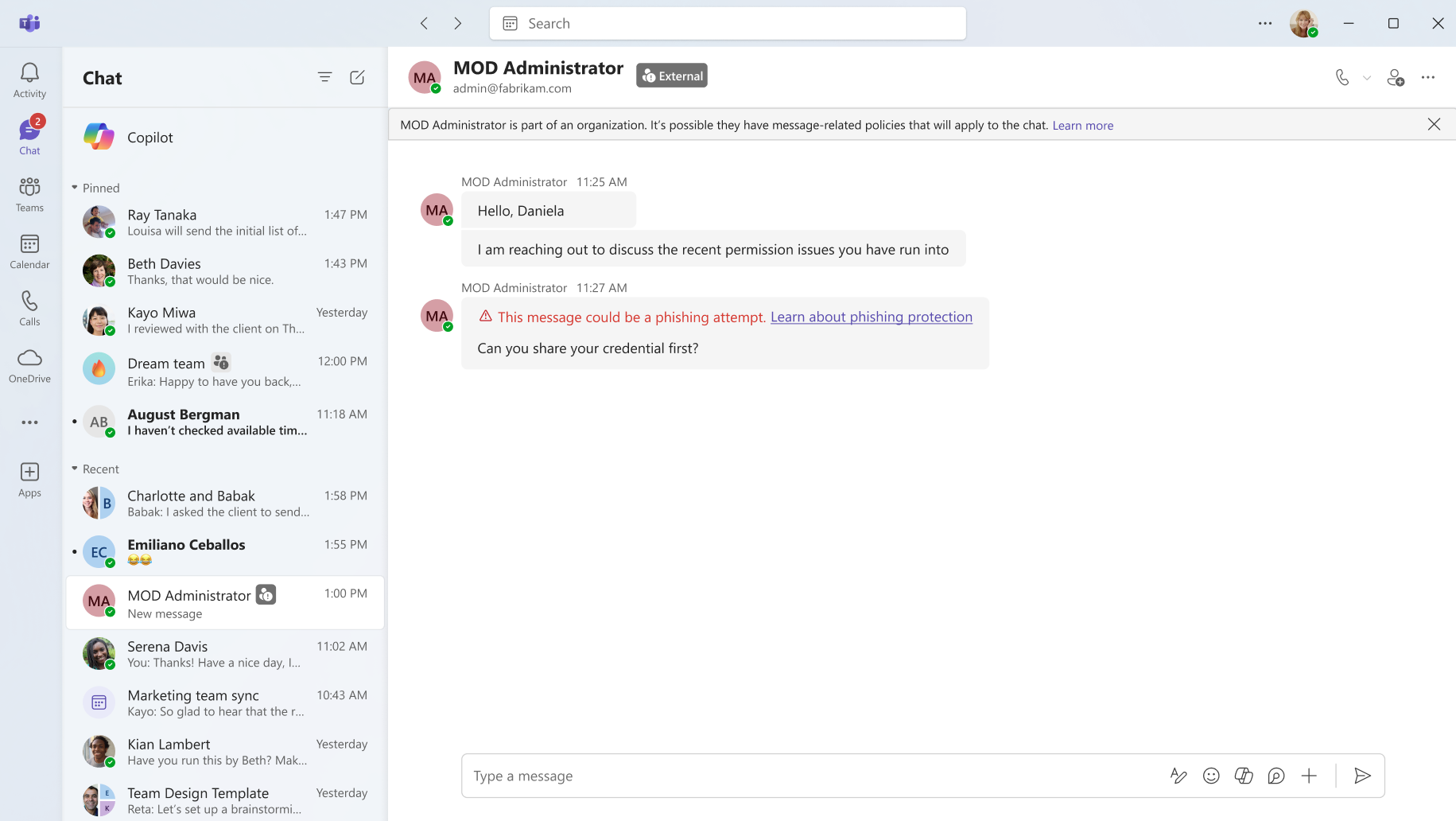
- For Teams mobile users in China, additional protection may also apply to in-tenant conversations to address fraud patterns observed in the region.
- This capability is used only for security protection and not for productivity, summarization, advertising, user monitoring, or other non-security purposes.
- Customer message content is not retained by the detection system for model training or other secondary uses.
- No new admin configuration is required.
[Action required and recommendations]
No admin action is required to enable this protection.
We recommend that admins review organizational guidance for interacting with unfamiliar external contacts and remind users to report suspicious activity or incorrect detections through available Teams reporting experiences.
Learn more
[Compliance considerations]
| Question | Answer |
| Does the change alter how existing customer data is processed, stored, or accessed? | Yes. Teams analyzes conversation context to detect suspicious behavior. The request states that customer message content is not retained by the detection system for model training or other secondary uses. |
| Does the change introduce or significantly modify AI/ML capabilities that interact with customer data? | Yes. The change introduces AI-powered, context-aware detection that analyzes conversation context for phishing, social engineering, impersonation attempts, and deceptive intent. |
Source: Microsoft Message Center • Analysed by MWPro